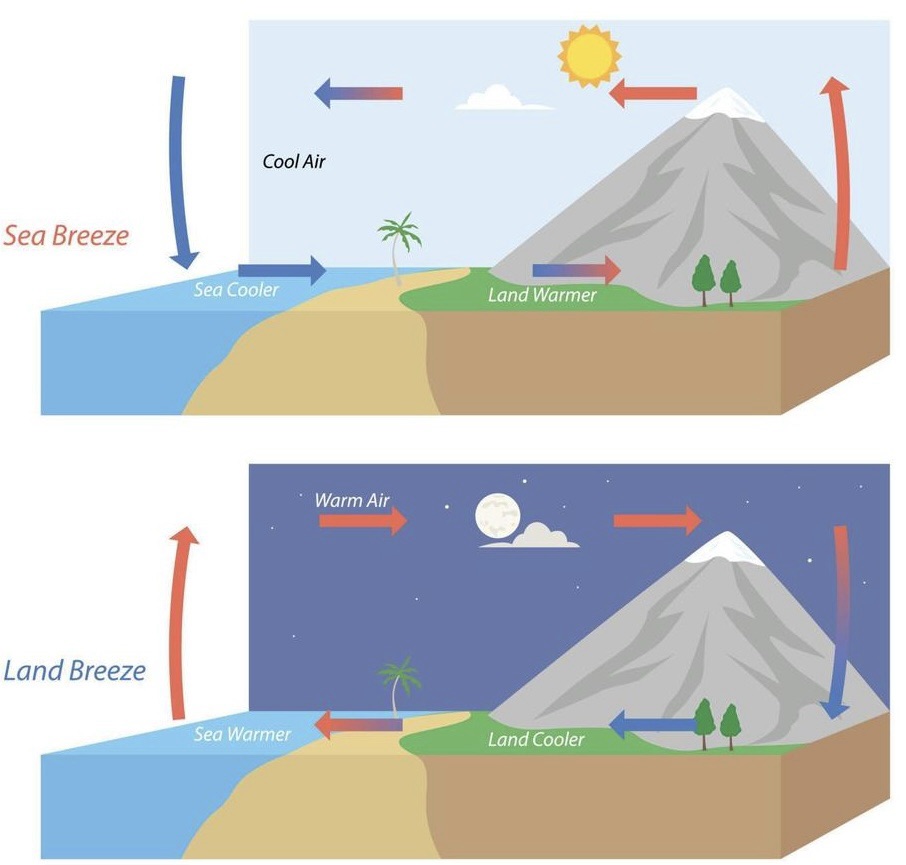
Air pressure at any height is the weight of the air above that level. Wind exists because air moves from higher pressure toward lower pressure, and this is true both at the surface and aloft.
During the day, land heats faster than the ocean. Air near the surface over land warms, becomes less dense, and rises. As it rises, air begins to accumulate at higher altitude over land, creating higher pressure aloft over land. Over the cooler ocean, air is denser and tends to sink, which removes air from altitude and creates lower pressure aloft over the ocean. Because air flows from high to low pressure at all heights, air at high altitude flows from land toward the sea. This outward flow aloft removes air from the column above the land, which reduces surface pressure over land, while sinking over the ocean adds air to the column there, maintaining higher surface pressure over the sea. The result is a closed circulation: aloft flow from land to sea, surface flow from sea to land — the onshore wind.
At night, the heating pattern reverses. Land cools faster than the ocean. Air over land becomes denser and sinks, causing air to accumulate near the surface, which creates high pressure at the surface over land. That sinking removes air from altitude, creating lower pressure aloft over land. Over the relatively warmer ocean, air rises, creating higher pressure aloft over the ocean and lower pressure at the surface. Air therefore flows aloft from sea to land, and at the surface from land to sea. This produces offshore wind. Again, the system is a closed loop — only the direction reverses.
For surfing, what matters is the surface leg of this loop. Offshore surface winds (land → sea) hold wave faces upright, smooth the surface, and allow waves to break cleanly and predictably. Onshore surface winds (sea → land) push wave crests forward, causing early collapse and surface chop. Because this circulation is driven by daily solar heating, it is strongest in sunny coastal regions with light background winds — such as Central America, Indonesia, Hawaii, Southern California, and Australia — where clean morning and evening surf is common. It is weaker or inconsistent in cooler, cloudier, or storm-dominated regions like Northern Europe, the U.S. Northeast, and southern Chile, where large-scale pressure systems overwhelm the local land–sea circulation.